
Social media should be an invaluable asset to a job seeker. At least that is the case if what we read is true. There are many stories of people landing a dream job with little more than a tweet on Twitter. Others will say it was their really great connections on LinkedIn, or friends who helped them spread their word on Facebook.
We’ve all surely heard that recruiters rely heavily on the use of social media for filling positions. It’s why we take down all of the party pics on Facebook, and stop beating our chest about politics or religion on Twitter. Those recruiters are watching. Right?
According to some people, recruiters and hiring managers are filling their quotas with the use of what they call “social recruiting”, but is it actually the way they’re telling it? Is social recruiting really the way jobs are being filled? I know what they’re saying, but I see something very different in what they’re actually doing.
As I see it, there are three very useful functions of social media for recruiters, as it applies to job candidates. I question how recruiters view each of these, and I have tried to identify which functions are considered important to them – if any. If you are a recruiter, please share your insight with other readers. In my estimation, the best social media assets for recruiters are as follows:
- Networking/discovery of candidates
- Candidate research
- Communications with candidates
Many people will claim that social media is highly important to recruiters, but I think we should test this theory in the real world. Actually, I already have done a bit of testing, and I have some good reasons to question the importance they place on each of these three facets I’ve listed. I will share what I have found.
First, for job seekers, I want to point out that the “old fashioned” job seeking methods are still very important. I will explain this by sharing my experience, and I really believe it should not go overlooked.
“Old Fashioned” Job Hunting is Still Important!
My search started out really exciting, but a little bit “old fashioned”. Even as a person who has written more than a million words about social media, including a book, my first efforts were the old fashioned way, combined with the use of social media.
It was a calculated effort. I carefully considered companies where I would love to work, and I did my research on them. I connected with employees, asked questions, learned about the company culture, and developed a good picture of the company and their needs.
I defined their expectations, and I formulated my approach. I wrote out a brilliant résumé and some amazing cover letters. I built my case by explaining all the great reasons I would be an asset, and also how much I would enjoy being a part of their organizations.
I sent my letters to the people in charge at the companies I had so greatly admired. I even sent them by FedEx to be sure the right people received them. That should work, right? It should at least help.
Recruiters and Social Media Candidate Research
Where I imagined the social media would be most important to these chosen companies was in the area of candidate research. If the human resources department and hiring managers were going to use social media as a hiring tool, they would find out a lot of great things about me.
In fact, if they gave social media much weight at all, I would surely stand out. My reputation is squeaky clean, people say nice things about me, and I’m even pretty popular by most standards. I have a ginormous blog readership (and no, I’m not calling you “husky”). Google search results for my name paint a picture of a successful executive – and not an ax murderer. I have over 25,000 followers on Twitter, a solid Klout score, and I look good by all of those other superficial measures that some people think matter. To top it off, about the most incriminating photo of me on Facebook is when I was caught wrapped in a pastel blanket and napping on the sofa snuggled up beside one of my children.

If social media was actually a significant factor to these recruiters, I should be a shoe-in.
Oh, but it is not so simple. I followed up on my efforts with telephone calls and letters. I refrained from belching, cursing, or any of the other big deal breakers. I subsequently discovered there are many reasons for not landing a particular job – or even getting an interview. There is a lot of competition.
Timing is also very important in a job hunt. Many companies will advertise that they are hiring for a given position, but that is often long before the position is actually to be filled. Some of them have already made their choice for a candidate and plan to hire from within, but they still go through the motions of seeing what else is out there. The list of challenges can get long.
There must be a good way to reach those recruiters at the right company and at the right time … right? After all, what about those amazing stories you hear about people getting jobs by way of social media?
I will share some example communications with recruiters by way of social media. This covers the rest of those three areas where I believe social media can be most valuable to recruiters – Networking/discovery of candidates, and communications with candidates.
Recruiters and Social Media Candidate Networking, Discovery, and Communications
I’ll offer just a couple of many examples I have seen. I intend for this to be constructive for the human resources/recruiting industry, and job seekers alike. I have heard things very similar to these examples from peers, and witnessed many other instances while watching companies closely. These are just two recent observations from my own personal search for the right company. I have every reason to believe that these are not just isolated incidents.
I will begin with an instance of a thriving company that approached me on Twitter. I want to note that they approached me publicly, and based on my research, nobody else before or since. Here is what they had to say:
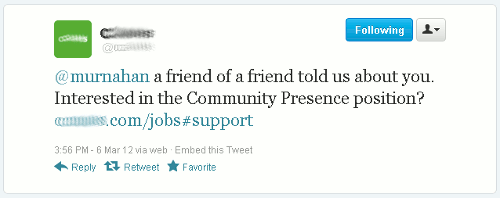
It seems they may have been interested, so I responded on Twitter within minutes and followed up with my resume and cover letter the next morning – March 7th. I never heard anything back from them by way of Twitter or email, so I followed up by email and Twitter on March 16th – ten days after their initial communication. I still never heard anything – but is this an isolated incident? Absolutely not!
Here is another instance where I have made significant efforts at communication with a company that is in the business of recruiting. They are seeking a VP of Marketing for their own company, and I have applied. I reached out by email, LinkedIn, Twitter, and comments on their blog. I have followed up very thoughtfully, and given them reasons to recall my name. I am not offended in the least if they are not interested, but I have done my part to show my qualifications, and given good reasons and opportunities to communicate.
Beep beep! Here comes a convoy of irony for you.
In a recent article on their blog, they suggested ways for people to use social media in their career search. There is about three truckloads of irony in that blog. Their company has a relatively anti-social social media presence, and frequently fails to respond to their audience at all – I’ve been watching. In fact in that very blog article, they were the only user to tweet it in the first day it was published, and I was one of only two people to comment on it.
My comment has still never received a response, and if you only have two comments on a blog, responding to them is Social Media 101 – the most basic. The writer has accepted my connection request on LinkedIn, but she stopped short of actually responding to my friendly email greeting – so she is just another blank space … a name and a picture. When I went to the writer’s Google+ profile, there was nothing to see, because she had not shared a single item publicly – only to her own Google+ “circles” and “extended circles”. She had not even made the articles she had written on the company blog visible to the public. To me, this seems to indicate a need for some training.
Look, I don’t expect anybody to hang on every word I say, but I believe that if I shared all of my communication attempts with this company, you may think they are nuts to not follow up with me. It would seem they should at least to keep me impressed with their company, because who knows – I may know a person or two. I’m trying my best to be unbiased, and I can legitimately say that this company is missing the big picture.
Incidentally, I was fortunate to have a few words on Twitter with the CEO / hiring manager for that VP position. I would describe this individual as a “Grand Poobah” of the recruiting industry, but yet, I would not call this person, or the company, an earnest user of social media. Here’s how it went:
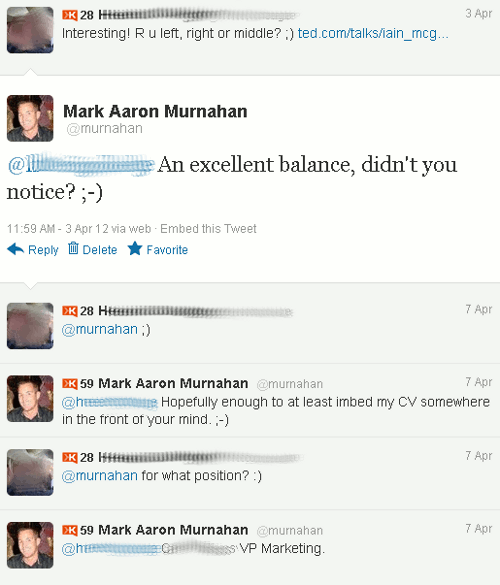
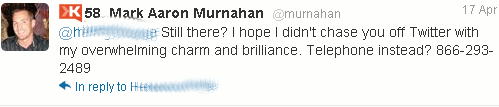
I followed up on this short communication with email on the following Monday. Then, after a ten day pause of complete silence from the Grand Poobah – and I mean the Poobah has not even sent a single tweet to anybody (publicly at least), I decided to check for a pulse and I sent this message on Twitter, and also another follow up email.
I Respect Recruiters
I respect recruiters – I really do, because I know it is a tough job to find the right people. I have been a CEO, so I know the challenges well. At the same time, I have my doubts about the weight recruiters place on the use of social media, and whether it is really as important as many people will say.
I recently read a study that claims recruiters only spend an average of six seconds per résumé as they scan through squillions of them. Unemployment is high, so there are a lot of people applying. It makes me wonder if recruiters ever really feel a need to look very carefully to fill a position. It also makes me wonder if they even have enough time to make a good assessment of an applicant’s qualifications – or disqualifications – based on social media.
That knocks a pretty big hole in the list of three things I estimated to be the most important uses of social media for recruiters.
With these examples in mind, and my assurance that I have a big stockpile of further examples, I want you to be the judge. If you are a recruiter, I want to hear your take on this. If you are a job seeker, I want to hear from you, too. Please add your comments and pass this along so others can share their insights.
Job seekers: Please feel free to give yourself a plug, and include a link to your résumé.
As a final note, I’m still looking, and I will relocate to anywhere in the USA for the right company. If you’re looking for me, too, please take a moment to get to know more about me and review my résumé.
Podcast: Play in new window | Download