Do you think you need a search engine optimizer? Let’s get serious. Your company is not a hobby, and you’re not working to build it only because the work is fun. Companies – smart companies – want to receive profit from their investment of hard work and money. Profit is what companies use to pay the bills.
It would be unwise to throw away your profit on SEO services just because you hope it may work out – someday. Don’t pretend to be shocked if I tell you that’s exactly what a lot of people are doing every day. I see it all the time that companies test the water and shakily hand over their credit card to the next SEO that gave them a good pitch. Other companies have all the skill they need for success, but they fail to use it.
I will give you some good pointers on how to select a good SEO, the basic components of their role, and even why you may (or may not) be able to handle much of it without their help.
SEO be damned, I’m going to tell you the truth you may not want to hear. It may sting, but it also may save you a lot of time, money, and frustration. I’m not just out to knock search engine optimizers, either. There are a lot of very talented SEO out there who just don’t want to talk to you because you’re trying to compare apples to airliners. As I tell you this, be mindful that it’s your business on the line, so if you’re getting this wrong, your company is the one that suffers.
SEO is a Double-Edged Sword
Don’t get me wrong about the value of good SEO. If you’ve got a good SEO, by all means, hang on to them. They are probably making you a lot of money. The problem is that statistically, most SEO are not very good at the job. Good ones are few and far between. It takes a lot of knowledge and experience to be really good at SEO. The best ones are also very well connected, and you don’t buy that for a few thousand bucks.
A truly qualified search engine optimizer can make an amazing difference in your business, but search engine optimization is a sword that cuts both ways.
Let’s make no mistakes about this: A legitimate attempt to reach your online audience can multiply your business, but an uncommitted and ill-considered effort can send it the other way … fast, and in more ways than you may realize. Rather than paying an inexperienced SEO who is still learning, you may do better to handle it yourself. It is true that a bad SEO can cost you a lot more than you pay them. Seriously – if you doubt me even a little bit, read about “Google Panda, Google Bowling, and How Bad SEO Can Kill Your Business“. If you’re trying to get by the cheap way, it’s like hunting for the cheapest root canal … it’s likely to hurt.
Do You Really Need Your SEO?
What makes you believe that you need a search engine optimizer? Think about that really hard. If you don’t have the right answer, based on the right strategy, it may be time to fire your SEO.
If your answer is that you have a legitimate business case for it, like most companies do, that’s great. Examine the business need carefully, choose your provider wisely, and make a strong commitment. Be sure that they understand your goals, and that they can provide a realistic forecast based on their work.
You should be prepared to pay them for that forecast, too. Otherwise, you are likely to make some huge strategic marketing errors. If you’ve chosen wisely, it will be worth every dollar you spend for their market research. If you get a good one, don’t expect to get their research for free. I’ll tell you why if you read that link I just gave you.
You should understand that even the best search engine optimizer will fail to bring you optimal results if you “kneecap” them with short budgets, “not enough time”, or other excuses. One of the worst things you can do is to make excuses because you are just too afraid to implement things they recommend based on their solid research. That frankly just pisses them off.
Understanding the math of SEO, and how it pertains to your specific business needs will matter more than you likely realize. I’m not kidding, and I’m not making this up. I’ll explain more about the math of SEO return on investment in a moment.
On the other hand, if your answer to why you need SEO services is that you’re trying it out because you are hopeful it will eventually have an impact, I have a suggestion: Fire your SEO immediately! Don’t pay them another dollar until you have a better answer. Hope alone does not create profit, and it can lead you down a really bad path. If you’re just “testing the water”, take your money and use it elsewhere in your business. There are sharks in that water!
Reaching a usefully measurable result with search engine optimization does not happen from “testing the water”. There is a bell curve (a gaussian function) at work, and it does not work in favor of minimized efforts.
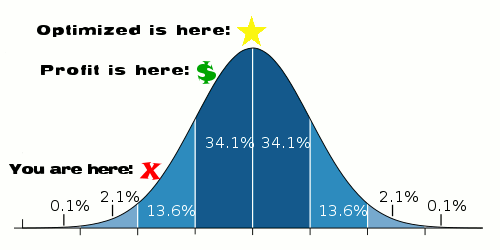
In case you never heard of The Pareto Principle – a widely used economic principle – it is worth the effort to understand it and apply it to your marketing.
Why to Fire Your SEO: Three Things You Should Know
SEO creates a lot of mixed reactions. If you ask a room full of business people about their experiences with SEO, you are likely to hear everything from extreme delight to extreme dismay. These few points are important to know if you want to avoid the dismay.
SEO is Not High Tech! I know that search engine optimization may sound very tricky and technical – and it is in some ways – but the technology aspects of SEO are only a small part of the “magic” a search engine optimizer actually does. I suggest reading “Search Engine Optimization is Not a Technology Job!” If you wonder if it is just one person’s opinion, be sure to read the comments to see what other professionals had to say.
If your SEO has ever led you to believe that their work is largely a matter of technical things, or that you don’t have the time or intelligence to understand what you are paying them for – Fire Them! No, wait … don’t fire them … incinerate them, because they are like zombies, and you don’t want them coming back to try and eat more of your brains again later.
Good SEO Are Smart Cookies! You should understand that you don’t just pay an SEO for what they do – you pay them for what they know, and for what they research on your behalf. If you want the best SEO results, you will need to hire some very talented and creative people.
Here’s the kicker: If they are smart enough to help you, they are also smart enough to help themselves. You should read further to understand “Why Good SEO Don’t Seek Your Business“. If you get a good one who loves your company as much as you do, get up off your wallet and book them before the competition does.
Otherwise, if you ever question their industry brilliance for a moment – Fire Them! Of course, I can’t condone criminal behavior, but you may want to keep a wooden stake handy. They are “un-dead”, so if you see their blood-sucking fangs – stake ’em!
$5000 is Not Half of $10,000! Maybe you think I just made a mathematical error, but I did not. I want to make a point about the vast difference between measuring efforts versus measuring results.
I already discussed the importance of having the right people handling your SEO versus the wrong ones. So, let’s assume you have the right ones – you are confident of it, and you are confident about your business goals. Let’s climb that bell curve that’s killing your success.
You can scale this to any level you like, but if you think that half of the effort will yield half of the result, you’ll waste money. The bell curve I mentioned has a nasty way of killing company hopes for profit.
Look at the bell curve of your industry’s marketing, and notice where the numbers make a sharp increase. Many companies will go right up to the curve and quit as soon as it gets too scary, but then slide back down because it was not measurable enough. A wise SEO knows that a business should push far enough up the bell curve to get the best results, but short of the point of diminishing returns.
If your SEO tries to take you to the shallow end of the bell curve because they are afraid to tell you what it will really take to make an optimal impact, then they are not doing their job properly. Many SEO dread trying to explain the vast difference between doing something and doing something well. In fact, it’s largely why I made the announcement that I stopped taking clients (it’s worth a read, by the way).
If an SEO is unable to explain the value of your strong commitment to their work, and if you are unwilling to hear it, don’t bother. Whether they realize it, they are doing you a disservice and they are lying to you. Fire Them! You can probably achieve mediocre results all on your own, so you shouldn’t be paying somebody else. Fire the SEO, and consider spending the money on an exorcism and perhaps a lobotomy – for you and for the SEO!
It can take a lot of climbing to reach the profitable part of the bell curve, but there is always a point when it becomes relatively self-sustaining. If you keep struggling just to stay on the shallow end of the curve, fire your SEO!
How to Fire Your SEO
I mentioned the matter of firing your SEO. Beyond the incinerator, the wooden stakes, and shoving them off a high cliff, there are other practical considerations. This is a tricky matter, because they have your passwords! You should change them … all of them. Even if you are the one trying to handle your own SEO like the dentist who went to dental school to fix their kids’ teeth – don’t trust the SEO. Any person who does not grasp the importance of this information should not have access to your company website.
If you want to get a better understanding of SEO, there are some basic lessons you should know. It doesn’t come without effort, but if you’re serious enough to read this far, you’re probably serious enough to read these valuable SEO lessons and subscribe for more to come.
Remember, I’m not telling you this to sell you anything. I’m telling you this because I witness too many people with their heads up a dark place and I don’t want my readers to be among them.
You are not stupid. Don’t act like it with your search engine rankings.
Photo Credit:
Fire Breathing by Luc Viatour via Flickr
Podcast: Play in new window | Download