I have been reaching out to some friends today, and it reminds me just how simple, yet valuable, saying “hi” can be. Some days, the networker in me takes over and I make time for just saying “hi” to people.
I often look through my Facebook, Twitter, and LinkedIn connections and seek out their telephone number to call and say hello. It often surprises people that I called them, because in many cases they were just “online acquaintances” prior to my call. When they hear a friendly “hi”, it can break the ice and open the door for a more meaningful and memorable connection.
Sure, you could say that you just don’t have time for it. After all, when you break the barrier between the broadcast effect of social networking and enter a more personal networking space, it takes more time. You may only reach one at a time with “hi”, but isn’t it worth a try?
How important can this be? I am not offering return on investment figures for this, but I can certainly say that it has been beneficial to me in many ways. Sometimes I find that people are really pleased that I took the time to connect by voice, and other times they wonder how I got their number (Tip: A WHOIS search can be very handy). I have often been met with kind questions about how my wife and kids are doing, or about something I recently wrote. However, I have never been met with insult.
Stop Overlooking the Value of “Hi”
“Hi” is a basic essential of networking, and yet it is so easy to neglect when we get busy or rely too heavily on a broadcast mentality. Networking with others and being friendly with a simple “hi” can have some very unexpected benefits. If you don’t believe me, just try it.
I love helping people to find what they are seeking. Whether they are looking for friends, customers, a job, or pink ponies, I try my best to know the right people to refer them to. That is the networker in me, and I have always enjoyed being able to connect people. Of course, that means knowing them, first.
It can be extremely refreshing to reach out to others and learn more about them. It is a great way to learn what motivates them, and that can be very motivating. With an attitude of seeking what they want, and how you can help them find it, you may be surprised how receptive people can be. When it is done without self-seeking, it can create some unexpected results. It can also create some great friendships and business alliances … you never know.
Today is Thanksgiving Day here in USA, and I am feeling very thankful. I hope that you are feeling thankful, too. When you consider the things to be thankful for in your life, it is nice to set aside all of that other stuff that diverts you from what matters the most.
I am thankful for many things, and I am going to share this with you and hope you can relate to it. This is not my typical blog article about social media, but it does include a very happy social media success story.
I began thinking about thankfulness and things which affect me and make me better. The list of thanks I owe is longer than I can dare to write in this short time I have while I prepare for my family’s Thanksgiving Day feast. I just want to distill this to my short list of things which really matter the most.
Good Reasons for Thanks: The People
Thanks for Family:
Above all, I must list my family. I have been blessed with a loving and devoted wife and three healthy and happy children. They are the kindest people I ever met, and beyond question, they are the best things in my life. They make me feel real, and they provide me with amazing joy from even the simplest things. I really cannot define the love this family brings to me, but it is my greatest source of joy and inspiration.
Thanks for Friends:
I am thankful for my many friends who bless my life each day. Some of them frequently have coffee or lunch with me, while some of them are thousands of miles away. Some of my friends counsel me when I need advice and caring, while some of them accept my counsel when they need advice and caring. Some of them have never shaken my hand or looked me in the eye, but yet, they are there every day … standing strong and carrying a flag for me.
Some of these friends I mention may not even receive very much attention from me, and they often know far more specifics about me than I know about them. All the while, these are people who drive me to do more, care more, and think more about every little thing I do. I thank these friends very warmly for this, and I hope that I may repay you in some way.
Thanksgiving Social Media Success Story
Today marks the 10th Thanksgiving holiday I will spend with my wife. In those ten years since we met right here on the Internet by way of social media, our lives have been blessed in ways which I could only describe as “astonishing”. The most astonishing of all is the people.
As you give thanks on this holiday, I hope that you will give some thought to these words. Without those people in each of our lives … and even those on the perimeter of our lives, we would not be the same. On the other end of that social media communication is another person who may be more important to your life than you credit them with.
Every Thanksgiving Turkey Has a Wishbone
Every turkey has a wishbone. My wish has not come into precise words for me just yet as I consider pulling on that wishbone. What I know for sure is that the things which matter the most for me are those people in my life, in every capacity, who drive me to carry on and always keep getting better. The people are my greatest cause for thanks, today, and that includes you! My wish may not name you specifically, but you are most certainly included.
I blame the Internet. Attack this all you like, but I blame the Internet and its many over-hyped success stories for allowing people to let down their guard and take a “witness” approach to their marketing. We all know that the Internet is a hugely important tool to businesses, but the lack of understanding how and why the Internet is valuable to a company has led a lot of people to throwing their hands in the air and giving up participation in their marketing. It is a knee-jerk reaction people make because all that information about Internet marketing is beyond the comfortable things they understand.
What makes this worse is that as so many people give up trying to be participants in their marketing efforts they give up on even knowing the right questions to ask or directions to take. It is as if they just throw all their fate to Google and a few other websites, and hope they get the right results.
A Non-Participant Seldom Gets Exceptional Results
I received a message a couple days ago that bothered me. It bothered me enough to write this, but it was a message that I see every day from small business people. I want to share it with you, but first, I want to say that this is a good example of why small businesses remain small.
The real problem is the sentiment and lack of attention, and not the actual message content. The sentiment is that of a business owner not really wanting to be a participant, but rather simply a witness to their business. I see this all the time, in a lot of different forms. Obviously, the most common way I see this is in marketing, because that is my job.
I will share the message I received that inspired this topic. On the surface, this may be easy to question how it shows me a lack of business participation, but I will get to the point of how apathy and lack of involvement are common attributes which often destroy small companies. The message reads as follows:
Please provide me with a quote for search engine optimization of my website xxxxxxxxxxxxxxx.xxx.
Thanks,
xxxx xxxxxx
Maybe you think I read too much into this, but let’s dig a little deeper and consider the implied “hands off” hope of being ranked in search engines … or the hope to sell more goods or services with little or no effort.
The email, which came through a form on another of my websites, did not even include a telephone number or good time to discuss their business objectives (although it is requested in the form). Does this person want three customers per year, or 1,000 customers per month? OK, so they just want a dollar figure. If SEO is a commodity, as many people wish to see it, then why do some people have huge online success and others (most) never see a dollar’s worth of benefit?
You could say that this individual did not understand that SEO (search engine optimization) is much more than just some fancy programming code that is put into a website to magically bring in the business. The page they visited just before clicking on my contact page clearly explained things in human terms, but what confusion did they absorb just before they read what I told them? Maybe they just thought they were buying pink ponies and fairy dust like so many other people in online marketing tried to sell them. Maybe they do not actually believe that search engine optimization also means researching the search terms with the highest possible ROI (return on investment) to rank for, fixing any technical deal-stoppers, creating a strategy, and more than anything, discovering and promoting the reasons anybody would want to do business with the company.
Without a purposeful message and understanding who to reach, how to reach them, and what message to reach them with, the whole effort is lost. I’ll bet this guy didn’t think of that. In fact, I’ll bet he will be suckered out of whatever few dollars he is willing to part with. Yet, he may never consider the cost of his missed opportunities. He will probably totally deny the fact that marketing done well, including proper and accurate mathematic, demographic, and psychographic research, will always provide a positive return on investment. I did not say “sometimes” … I said “always”, and that is a truth that most non-participant business owners fail to grasp. It will often take more money, effort, or time than the impatient non-participant business owner is ready to face, but if they are willing to do it right, it will earn them more money. Tragically, it is also a truth that most SEO fail to grasp. Yes, I said “most SEO”, and if you disagree with that, then you must not have seen how many people with three weeks of marketing experience call themselves a search engine optimizer these days.
How Do I Define a Non-Participant Business?
You may wonder how I define a non-participant business, and I will explain this with an example.
As I looked at the website this individual wants to have optimized, I found that it was created with Microsoft Word. It was a really terrible “do-it-yourself” job with no call to action whatsoever. It has zero known incoming links from other websites, and even the business address was in the form of an image instead of text. It was really a great example website to reflect all the worst possible scenarios for ranking in search engine results, and more than I will get into in this article. It was like one of those awful at-home haircuts you see while standing in line over at Wal Mart. Yes, this person really needs some proper assistance.
What makes this story better is that I took a few minutes, out of sheer curiosity, to make a good estimate on his potential reach and effectiveness in his marketplace. I found that if they were willing to pursue a path for success, they could pave their street with gold.
Will I contact this person with a proper SEO proposal? Absolutely not, and I’ll tell you why. It is a non-participant! Only a non-participant would ever try to develop a website using Microsoft Word and ask somebody to fix it with SEO magic tricks. Only a non-participant would overlook the need for proper marketing instead of believing in the Voodoo which people make SEO sound like. Asking for SEO, while every other available factor in my cursory marketing audit of this company showed horrible results, is not good business sense, and it is not the mindset that makes for a successful outcome in any business plan.
You may recall hearing the term “survival of the fittest”, and I am here to testify that it works exceedingly well in the business world. It works just the way it has for millions of years, except it works even faster when you apply it to Internet marketing.
Simply “SEO-ing” a website to rank highly for search phrases is like spitting on a house fire and telling the insurance adjuster that you tried to save it. Asking the search engine optimization professional to SEO your website in this manner is like calling the fire brigade and directing them to spit on it for you.
SEO is just one tactic in a larger marketing strategy. Until you grasp that concept, you are just spitting.
Please realize for just a moment that money alone will not create success in small business marketing efforts. OK, maybe with huge amounts of money, but not the “get it fast and cheap” amounts of money that most small businesses bring to the table. Success takes participation, and often a lot of it. It means having a direction in your business, being ready to follow that direction, and changing direction as needed.
Why Small Companies Are Small
Small companies are small for a reason. That reason varies a lot between companies, but it is often because of lack of participation and attention to the things which grow a business.
Many small businesses do not have the resources in place to oversee important areas of their business growth. When they lack the needed personnel to manage things like legal, accounting, marketing, research and development, and etcetera, they must improvise. That can create a huge burden, but if it was easy, it probably wouldn’t pay very well.
Putting somebody in charge and delegating your weak points is fine, in fact, it is a great idea. However, when it comes to your marketing, the part of your business where it reaches the customers, you should pay close attention to getting it right. Marketing is what will direct many of the other growth factors in a business. Lacking participation and just being a witness in your marketing can cause a chain reaction that destroys many other areas of a company. Marketing is an integral piece of a company that brings in money for all the other things a company needs.
Try asking a couple of marketing professionals how often they find themselves waiting on clients to complete simple tasks. It is often startling how much a marketing person has to hound clients just to send over the pictures they said they were going to send last week, or the reports they asked for two months ago. Willingness to pay attention and complete simple marketing related tasks is often reflected in the overall success of an organization, and it is what I call being a “participant” rather than a “witness”.
I am not trying to sell you this idea, because you can probably already see it in companies all around you … maybe even your own.
I recently visited with a friend who is pretty aware of technology, but he still feels a bit awkward when it comes to blogs. He spoke of how subscribing, commenting, and joining into a discussion can feel a bit daunting if you are not sure how it all works. When I looked at it from his perspective, I realized how right he was. Perhaps bloggers don’t look at things from a new user perspective as much as we should. We should try harder to be more welcoming of the uninitiated, and that is what I hope to do here.
I am writing this for you, whether you are completely new to blogs, or an experienced blog owner who may have forgotten how lost you felt when you were just figuring this blogging stuff out for the first time. I also want to inspire you with some significant benefits of participating in blogs.
My friend mentioned how some people have their little picture by their name, and wondered how that happens. He really snapped me back to the reality that this whole blogging thing can be a little confusing to “ordinary” people (as opposed to “blog people”, of course). I intend to help clarify some issues of how to participate in blogs, how to find blogs worth discussing, and how it can benefit you even if you are one of those “ordinary” people.
I will begin with the very basics, so if you already know this, I urge you to be reminded that many others do not. If you have your own blog, it is easy to forget all that stuff you have learned about blogs and how they work. Here is a question I have heard more than a couple times:
How Do I Get My Picture to Show Up on Blogs?
I suppose I will begin with that little picture beside peoples’ name. No, it does not mean they are a member of some elite blogging fraternity. Having your own unique picture show up on blogs when you comment is as simple as creating an avatar. More specifically, a “Gravitar” which is a globally recognized avatar image that you can use in more places than a Visa card (that’s a lot).
Gravitar Setup: In order to set up your Gravitar, simply go to Gravitar.com and sign up. You only need to do this once, and it really is easier than you may expect.
There is a benefit to the image, too! A graphic along with your comments can be strongly identifying as people read through comments, and especially at blogs where you plan to return often. People will identify with your avatar faster than by reading the names as they read through comments. If you are interesting to them, they will be looking for your image.
They Want My Email?!
I am probably the most reserved person you ever came across when it comes to giving out my email addresses. In fact, I am borderline obsessive about this. I love having a clean inbox, and I hate when people clutter it with junk. This is especially true with some of my prized email accounts like my very special one that is only seven characters, including dots and the “@” (example: x@xx.xx). Yes, I hate giving out email addresses on websites!
Gravitars are based on the email address or addresses which you specify at Gravitar.com. Most blogs and forums use Gravitars to pull in your avatar, which is why they ask you to enter your email address. Of course, email addresses are also one way that blog administrators can quickly blacklist people who spam their community with useless or offensive comments. This is a good thing … a very good thing.
If it makes you feel any more comfortable about the matter of email, I have a specific email address which I use for commenting on blogs, and I receive no spam at that address at all. I really do feel totally safe on this matter. Additionally, many blogs allow you to use your image from other services like Facebook, Twitter, OpenID, Yahoo! or others, but don’t get flustered. I am getting to that part, and it will be easy … have a little faith.
What About Commenting Systems Like Disqus and Intense Debate
When commenting systems like Disqus and Intense Debate came along, I was really reluctant at first. I liked the good old standard system of entering my name, email address, and website address, adding my comment, and clicking “Submit”. That made sense to me, and it was so simple.
Now let’s have some “whisper time” while I tell you a little secret …
[Mark leans in close and screams into ear:] Disqus and Intense Debate Do Not Require a Signup!
This is the one thing that made me so frustrated when I saw these commenting systems gaining popularity. It appeared that I needed to sign up for more stuff. I already had my Gravitar, and I just wanted to add my two cents to a blog. Why did they make it so darn confusing all of the sudden?!
I am really glad that my buddy brought this to my attention, because I felt the same way. Somehow I had this misconception that because the blog commenting systems allowed me to log in, that I needed to log into something. This is not the case at all. You do not need to set up a new account to use either of these systems. If you want to make a comment on a blog using any of the popular blog commenting systems, you may comment as a “Guest”. You can still add your email, use your Gravitar, and add the link to your website. Let us end that confusion right now, and put a period after it.
The benefits of these systems are numerous, but optional. They allow you to click a button to use your Facebook, Twitter, OpenID, Yahoo! or other profile information, but it goes further. They also let you easily share the blog articles you comment on, along with your comments, across social networks. Sharing is still optional, even if you log in using these services, but there can be great cases for alerting friends on what you are discussing on a blog article and getting their opinions, too.
There is still more benefit! These services also aggregate comments that you make on different blogs into one place where you can go and see replies to your comments, and thus making it easier to respond to them, ask or answer questions, build rapport, build community, and etcetera. They also include profiles that you can use to follow other users’ comments and join in their communities of interest, too. Of course, I cannot give you my login to see all of the goodies, but here is my public Disqus profile which shows comments I make on other blogs which use Disqus.
In my opinion, these are some really useful tools, and more bloggers would probably adopt their use if they, and their readers understood the full benefit and usage. That means ending the confusion surrounding them, but I am trying! I use Disqus commenting system here on this blog. Try it out by adding your comment. It really is as easy as I said.
How to Find Good Blogs
Can you believe how many blogs there are out there on the Internet? There must be a squillion people blogging about everything from A to Z. Finding the good ones which fit your interests can be a lot easier with the right tools. Try a Google blog search (http://blogsearch.google.com/) for things which interest you. Try a Twitter search, and monitor it regularly! Even if you do not have a Twitter account, you can still find a lot of value in the search features. Get creative and try it out at search.twitter.com and be sure to try the advanced search. There are also a lot of blog aggregation services like Blog Catalog and Technorati, along with many which are targeted to specific interests or industries.
A great place to find useful blogs is by paying attention to what people with your same interests or in your career field read. You can often find that out by watching their Twitter, Facebook, Digg, or better yet, go look to see which websites are linking to their website by searching their web address on Open Site Explorer. If they leave comments on blogs, you can bet the links will show up. Just think of all you can do with that information.
Once you find some blogs you like, subscribe to them! You will really not get much benefit from a blog if you make it easier to overlook them. I use Google Reader to subscribe to many RSS feeds, but I subscribe to my favorite blogs by email and by RSS just to be sure I keep in touch with them. If you want to know more about tools to help with blogs, I strongly suggest reading “6 Essential Blogging Tools for Bloggers and Non-Bloggers“.
SEO and Blog Commenting
Why should you participate in blog discussions? Have you ever heard of WiiFM? It means “What’s in it for me?” You want to know the answer of what’s in it for you, right? After all, you are still human, even if you are one of those “blog people” I mentioned.
The benefits of blog commenting are not just as they seem. Certainly there is a strong benefit from a SEO (search engine optimization) standpoint, but let’s not get irritating with that! I will touch on this topic and then move on. If you take this as a suggestion to go out with a hope of leaving meaningless comments on a bunch of blogs to become popular, you will not be popular in the way you like. In fact, I consider it a horrible SEO strategy (but very common) to try and use blog comments to build up your incoming links. Sure, blog comment links can be quite valuable, but without being courteous and useful, you are just peeing down your leg. You will find a much more profound benefit by being useful, and I will explain that.
Think of it this way, if you try to use blog commenting as a tool for SEO, imagine how much greater value you will find if your comments make people like you and want to know you. If they come and read your blog, they may like what you have to say there, too. This is precisely the reason my blog here at aWebGuy.com is listed with a link from every page of a whole lot of blogs in their “Blogroll”. They are also more likely to reference you with a link in one or more of their articles. That seems a lot more valuable to me than the SEO value of links from a few comments I made. Wouldn’t you agree?
NOTE: To all of those who have blessed me with a link in their blogroll, or in an article, I truly appreciate you! I am still planning to add a blogroll here someday. In the meantime, I still try to write something about you whenever I can.
When you comment on a blog and include your URL (website address), it will appear as a link on most blogs. Those links are what search engines use to discover and judge the value of websites. More links means more value, but of course it is not that easy. More of the right links can add huge value. The SEO tactic of seeking blogs with great search engine ranking just to leave worthless comments misses the target in a big way. Just imagine if you said something funny, interesting, useful, or otherwise put your unique spin on a topic. People are more likely to like and respect you, and there is definitely a better chance that they will want to know more about you. I have gained a lot of readers because they saw my comments on another blog and liked my take on things.
An example I recently suggested to a client was to use blogs to learn more about her related industries. She just opened her second Pilates studio in Aventura Florida. We talked about how to book up her new location by looking at who wants or needs her services.
We discovered that golfers can benefit from Pilates. I suggested that she read more blogs about golfing and get to know the community. She also said that equestrian is another area she sees a lot of business. I suggested getting to know the equestrian community in her area. Just reading about these topics, alone, can help her have a better conversation when these people contact her, but also give her a lot better understanding of their needs when it is time to write about these things on her blog. If she choses to comment on topics in these fields with something useful, she could become a lot more valuable to the community. It adds up over time, in a big way. Now, imagine how nice it will be for her if her website lands in the blogroll of a handful of related blogs because they like her input.
Good Blog Commenting
What is a good blog comment? Sometimes it is perfectly fine to add a brief comment just to thank the author, but it is far better to say what you really think. “Thanks, great blog post.” is about generic enough that you may just earn the sugar-free cookie award for being boring. Step it up a notch and ask a question, answer a question, or do something more than look like you are just trying to get a link on their blog. Trust me on this … bloggers are pretty skeptical about those “Thanks, great blog post.” people. There are thousands of people in India (no offense to my Indian friends) who are paid about four dollars a year to sit and add “Thanks, great blog post.” comments to blogs.
You can do better, and it really does make a difference! Doing better usually means that you should slow down and participate. The scan-and-click nature of the Internet leads to a lot of waste. If you actually slow down and give your attention to the blogs you like, and the blogs where you find value, you can create more value for yourself.
I should note that bloggers love comments, and it validates their hard work. It makes sense for it to be really easy and inviting for users to add their input. I would probably have a lot more comments here, but I am just crazy enough to put my toll free telephone number all over my blog. I love having brainstorming calls from friends and strangers. It keeps me sharp. My phone rings … a lot! Since most bloggers probably do not want my telephone bill, a fantastic alternative is comments.
Stop and Read the Comments!
Once you find blogs that you like, be sure to read the comments. Those comments are written by other people who may have similar interests and you may find that you really like them. You may find a connection to your next great customer, friend, supplier, or job. If you do not slow down and pay attention, you will never know. If you don’t leave your comments, they won’t either!
There surely must be some tension between the social media giants, Twitter and Facebook. After all, social media is a fiercely competitive and also very profitable industry. Once in a while, there is a blaring case of irony to make us laugh.
Irony:“… situation in which there is a sharp incongruity or discordance that goes beyond the simple and evident intention of words or actions.” (source: Wikipedia)
Maybe you will not find this as amusing as I do. After all, I laugh at a lot of absurdities that I discover online. Social media is fantastic for a laugh, and I may never get the pictures of people with back-boobs and front-butts out of my head. Yes, that’s right, I said back boobs and front butts. See for yourself at your local Wal Mart store, or follow the humorous links I provided.
NOTE: I know some fine people with back boobs and front butts, but let’s face it Snuggies are cheap, and they could disguise that stuff better than Spandex!
Now back to this social media irony of Facebook and Twitter. We have all heard that we should be using Twitter, right? Anybody in the marketing industry will, at a minimum, recommend reserving your brand name at Twitter.com.
Twitter grew like influenza since 2007, and millions of people flocked to the service to find out what a “tweet” is all about. I must say that it was not without merit, and I have participated quite heartily in the conversation surrounding Twitter.
Long before Twitter … centuries before Twitter (in Internet time, of course) we had Facebook. Facebook really hit the world by storm, and grew to over 500 million users in short order. Do you realize how big 500,000,000 is? It is big … very big!
Obviously, Facebook has a stronghold in the social media industry, but we still cannot overlook Twitter for its complex simplicity. I like Twitter enough that I wrote a book about the service, so this is certainly not a bash on Twitter. It is just an observation.
I also like Facebook, and I can spend hours spying on the lives of nearly everybody I ever knew. Then, of course, there are those many companies who do not even see it coming while I am compiling the information I need in order to crush their business with marketing intelligence that I pick up on Facebook.
A logical and meaningful bash against Facebook is like slapping a hungry grizzly bear with a slab of meat and then hoping I can outrun it. It is one of those things that sounds stupid even when smart people say it. Facebook is a winner in the information age. Knock Facebook if you like, but 500 million kind of speaks for itself.
No, this is not a bashing, but I question how they see each other. What is a good way to open a dialog of speculation on how the two social media giants view the others’ service? Make up your own mind on this (and please share your comments), but to me it seems that a look at each of their usage of the others’ service should say something. What it says could be taken different ways, and I will let you chime in with your thoughts.
Twitter on Facebook
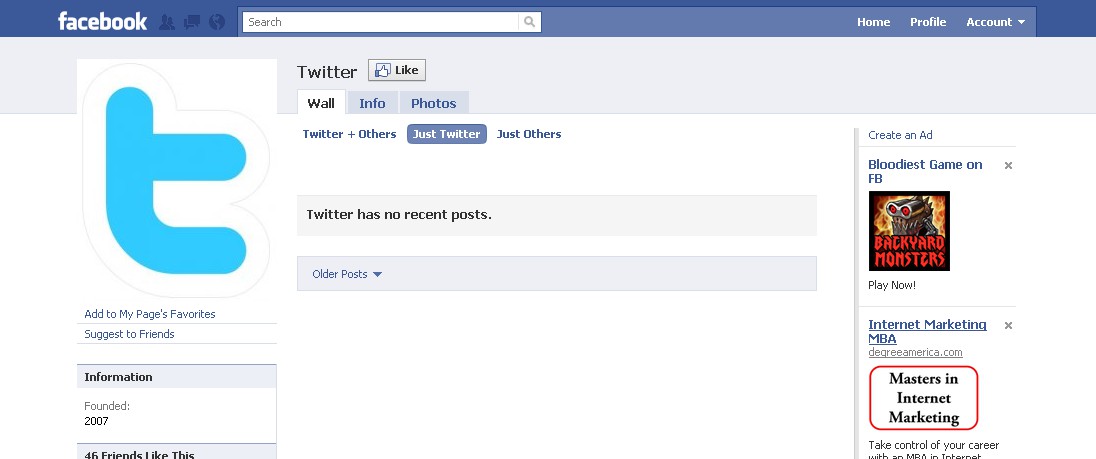
Twitter has a Facebook account with hundreds of thousands of fans. My logical assumption would be that Twitter may actually have something more than 140 characters (the character limit on Twitter) to say to all of those adoring fans. Sure, they have a blog, and of course they have Twitter, but it seems that Facebook is not just “the competition”, and it could serve some great uses for Twitter. It seems that Twitter did not ask for, nor act upon my opinion … or the opinion of the 714,256 people who elected to “Like” them on Facebook. As the image below illustrates, “Twitter has no recent posts.” Surely they have something available if you click on “older posts”, right? No … nothing at all. They signed up for an account and did not use it, just the same way as the overwhelming majority of accounts created on Twitter. Irony? Just wait, because there’s more!
Twitter on Facebook
Facebook on Twitter
I guess I never really pay much attention to Facebook on Twitter, but they are there, and using the service. When I want to know more about Facebook, I either look at Facebook or find it on one of my favorite Facebook-focused blogs. Facebook really does not need Twitter, but they apparently found value in embracing Twitter as another tool. I commend them on the choice to use Twitter, and it just makes good sense to me.
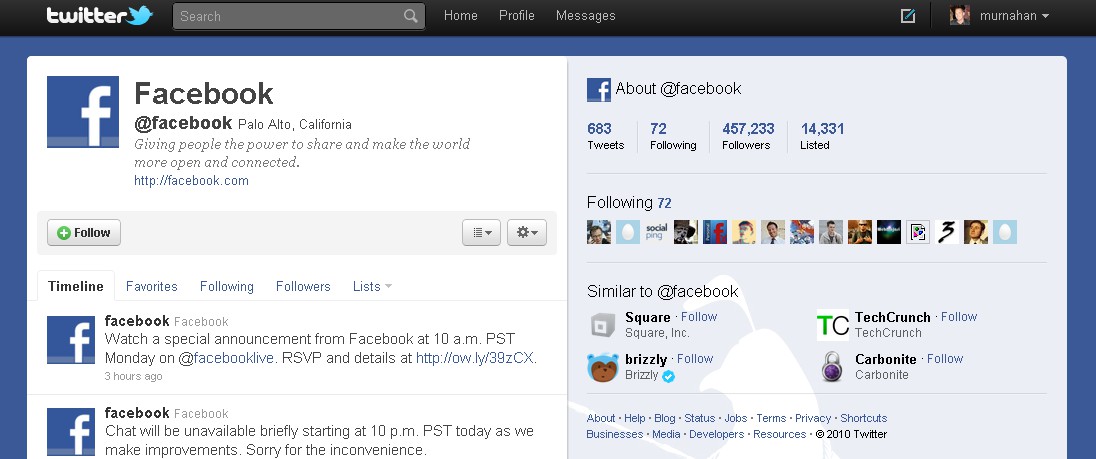
In contrast to Twitter’s blank Facebook page, Facebook sends updates using Twitter. As illustrated in the image below, Facebook is not a huge user of Twitter, but has sent 683 tweets since their account was created in March 2007.
Facebook on Twitter
Does Twitter Really Hate Facebook?
I guess it is a stretch to say that Twitter hates Facebook, but it is pretty clear that they do not have anything to say to the people who chose to “Like” their Facebook page. It seems that they could at least try it out and perhaps come out and say “tweet”.