Blogging Tips: Use Evergreen Content and Revive Your Archive

Evergreen Content Lasts!

Have you ever noticed that when you visit a blog, you generally only look through the most recent articles? It is pretty common that upon visiting a blog’s home page, people will just scan through a few items and see if there is something they want to read. In the blogging world, it is often assumed that newer is better, but this is quite often not the case. It is just more visible.

I am guilty of looking at the date something was published. I am not sure why in some cases, but I guess I am just so accustomed to seeing a date on blog articles. I suppose it is just one more way that people can feel that they are getting the latest and greatest news. A reality check for bloggers and readers alike can come in the form of these two little questions:

  • For Blog Readers: What about all of the great information that is not just recent or new?
  • For Blog Authors: What about the people who are not there for the news, but who just want great information?

I have noticed many blogs removing their publish date from articles, and it actually makes sense for some blogs. If the information is still useful, does it really matter whether it was written this week, this month, or even this year? A lot of great information is timeless. As I ponder this, I am reminded of an article I wrote about eight or nine years ago on the topic of H1 tags titled “H1 Tags Improve Search Engine Placement”. Thousands of people per month read that article. It is the top ranked article in search engines on the topic, and has been since the day I published it. Does the date really matter? H1 tags (web page headings) are still as important today as they were then. The information is still useful.

Some Blogs Are “Evergreen”

When I say “evergreen”, I mean that the information is as useful a year from now as it is today. Blogs have widely varying degrees of “evergreen” content, but most business blogs will have a good level of content that is still relevant and useful for a long time. It would be pretty hard for most businesses to have a blog that was no better than a used newspaper.

For blog authors, it can sometimes feel like a huge shame that people are actually missing some of your greatest pieces of work. So what do you do? Do you try to make everything more genius than the last? That is a good idea, but it is probably not always going to work. In my case, I know darn well that some days I am just a whole lot less brilliant than I would like. I often write blog articles on those days, too.

Scanning through the first few items listed on the home page of your blog is often how new readers will decide whether to come back, subscribe to your blog, or schedule an afternoon of reading through page after page of your past articles. This makes it pretty important to have something right up front to impress them, but how? You cannot just leave your best work parked on the front page of your blog forever. Your regular readers would get sick of seeing it. Do you just stop blogging until you can come up with something to beat the last piece? That is probably not the best answer. In fact, that is a pretty terrible answer.

You could republish some of your best work, but the same problem of repetition arises when you consider your long-time readers. Plus for many blogs where the date is part of the URL, there is the tragedy of changing the URL where all of those great incoming links are pointing. Sure, a 301 permanent redirect to the article’s new location is easy, but you still lose some of the link value for those older works.

Of course, you could just count on excellent search engine ranking for everything on your blog, and use Google as your website navigation. That way, if they are looking for it they will find you anyway. I have often counted on this, but then again, search engine optimization is my job. What about the people already on your blog who may find some of your past articles to be really useful? Larger websites often have a user-friendly sitemap to help people find useful information. The equivalent for a blog is the archive. Website search tools are excellent, but some people want to browse, and you should make it easy for them.

What about all of those readers discovering your blog from an older article? Will they even notice your most recent brilliance? What can you do to grab their attention to your latest and greatest stuff? Maybe a better solution is to create more evergreen content and to revive your archive.

Revive Your Archive!

Scanning the home page of a blog makes sense if you are a regular reader who has participated in the blog for a while, or if the blog is mostly about recent news. Let’s face it, though, many blogs are full of “evergreen” content that is not just seasonal or only applies to right now. If this is the case with your blog, it is a good idea to promote some of your past articles for those who may have missed them. The trouble is that you don’t want to annoy your current readers by saying the same old thing over and over. So how do you deal with keeping things current and fresh, while also being sure that people can see that you have been brilliant long before they happened upon your blog?

You can tell where this is going, right? Sure, I want you to go back and browse my blog archive. There are some excellent tips there, and a lot of information that I am confident can help you. I also want to be sure that you are thinking of this with your blog, so I am not just being selfish.

Make Your Blog Archive Easy to Navigate!

I have noticed that it is easy to assume that I have not missed much on some of the blogs I regularly keep up with. However, I still sometimes like to go back through the archives of my favorite blogs. Sometimes this can be a hassle, and sometimes it is a breeze. Now consider the people reading your blog, do you want it to be a hassle for them, or a breeze?

There are a lot of types of archives, but many of them require a lot of clicking back through a chronological month-by-month archive structure or going to the end of the page and clicking on a link for previous articles. Some will have archives nicely paginated so you can flip through them quickly. Other blogs seem to make it a challenge to read what they have had to say in the past.

A lot of blogs have killed their tag clouds, and do not even show their tags on posts. I still love them, and appreciate bloggers who make a tag cloud available, or at least tags on individual posts. For example, go click on a tag for this article (listed at the bottom, such as ) and see how easy it is to find more related information. Some blogs do not even list the blog categories for articles. Call me old fashioned, but I still love tags and categories. I can use them to find other things with similar information. I think I love them even more because I know from my website statistics logs that they are used extensively by readers on my blog.

I hope that you will consider your archived blog content and how you may keep it easily accessible. Making it easy for people to find and for them to browse could add up to a lot more subscribers over time. You may notice that on my blog, I have my archive linked at the very top of every page, just below the recent articles listed on the left, and at the bottom of every article along with links to my most recent articles. Isn’t redundancy awesome?

RELATED ARTICLES:

Image credit to MPF via Wikipedia

Are You Ready to Market Like Einstein?

Market Like Einstein
Marketing is what makes things sell, and it is what makes businesses profitable. Without marketing, whether word of mouth, television, radio, print, Internet, or some other medium, even the best companies with the best products will fail. Somebody has to make buyers aware of an offering, and do so in a desirable way, before it will sell. That is marketing in a nutshell.

Great marketing takes us by the nose and leads us to a brand. The best marketing makes us think. Sometimes it makes us laugh, and sometimes it makes us cry, but it always makes us think. When it makes us think enough, it makes us talk about it. It enters our conversations around the water cooler, at little league games, sitting at a bar among friends, and in boardrooms. When marketing is done at optimum levels, it permeates our conscious and our subconscious. That is the kind of marketing that makes the difference between Fortune 500 companies and all the others who came and left. It is also the kind of marketing that makes the difference between your little company and the little bigger company you want it to be. It only makes sense for you to want to know how to market better.

Marketing is not just about putting your words out to a bunch of people. Marketing also means bridging the divide between the way a producer thinks and the way their consumers think. It is not something that everybody is built for, but it is something they can practice and become better at. A lot of people can perform the more menial tasks associated with marketing, and millions of them can clearly send a tweet, update their Facebook, spam LinkedIn, or write a blog. Only a relatively few will make the necessary sacrifices of planning, learning, and stepping outside of themselves enough to do something truly brilliant that attracts people to them. It is precisely why marketing is not, and will never be a commodity.

Today’s Murnahanism: Good marketers must answer why their marketing is more expensive than others. Great marketers refuse to answer, because they don’t want the client who doesn’t already know.

Brilliant marketing comes with a cost. The cost can vary greatly, and I don’t just mean money, either. It often comes with the cost of a marketer who studies people and understands what drives them to take action. It takes somebody with a uniquely analytical mind who thinks differently than those around them. It comes with a whole lot of what I call “brain sweat”. If you are unprepared to afford these traditional costs associated with brilliant marketing, you had better be ready to sweat a lot, with your brain.

Are You Ready for Einstein-Style Brain Sweat?

If you are dedicated to your marketing, you must exercise your thinking. Einstein was a great marketer. Although it was not his vocation, in many ways he was one of the best marketers ever. After all, we have all heard of him, and he was quite effective at selling his ideas to the world. If you think it was easy, just try marketing theoretical physics and see if you can make a household name for yourself. Some of Einstein’s greatest struggles were in bridging the gap between his thinking and the conventional wisdom around him. He had to look at things from other peoples’ perspective in order to understand how to best explain his thoughts to them, and thus “sell” his ideas. The cost to Einstein was that he was criticized by many and became a bit “crazy” by some standards. Brain sweat does that to a person. It is a huge challenge to carry such divergent thoughts of both the producer and the consumer and know how to package them and sell them. In my estimation, this is the greatest challenge of marketing.

The best marketers I have ever met are all just a bit “crazy”. I think most marketers prefer the term “eccentric” over “crazy”. Trying to think like other people is tough. It was tough for Einstein to try and think like others around him enough to get his ideas through to them, and it is similarly challenging for many people trying to market their product or service. It tends to stretch a person’s imagination. It is like a rigorous brain exercise, and like any exercise, it makes you stronger with repetition.

I have often been called “eccentric”, but if you ask me, I am crazier than a shithouse squirrel (I wanted to say “shithouse rat” but my editor asked me to change it). I push myself just a little closer to insanity every time I try to understand people and how to most effectively market something to them. It is my job, and I quite enjoy it. They say there is a fine line between higher thinking and insanity. Personally, I try my best to straddle that line with one foot on either side. It beats being bored. It does not mean that I am calling myself smarter than others, it just means that I use what brain I have, and I push it to an uncomfortable limit where the competition is not willing or able to go. That is often what it takes to create the best marketing.

Einstein kept pushing forward even when other scientists were not on his side. He knew his product, and he persevered against the odds. Einstein was fortunate to have much assistance to see him through his research, but most businesses (and most other theoretical physicists) are not so fortunate. Albert Einstein’s marketing was often just good enough to receive his next round of funding and to continue his work. Most businesses only have one shot to get it right, and to achieve enough market penetration to sustain them through to the next higher level.

Are You Feeling Brilliant Yet?

The process of learning how to produce great marketing is long and hard. It would be great if I could just hand you a “brilliant switch” that you could turn on and instantly start thinking like your customers. I don’t have a learning course to sell, and although I say that I am for hire, I say “no” to the vast majority of the people who try to hire my services (largely because I am not cheap). What I can offer is a pretty sizable blog archive of marketing articles that may help jump start your thinking about your customers and how to address the challenges of marketing what you offer. I hope that it will help you.

If you are not ready to think more like your customers and dedicate more of your mind to your marketing, it is best to leave it to the people who do it for a living. Otherwise, you risk regurgitating the same old junk that has become so commonplace on the Internet. It does not work the way many people may lead you to believe, and it comes at a much higher risk of failure.

Grammatical Reasons They’re Taking Their Business Over There

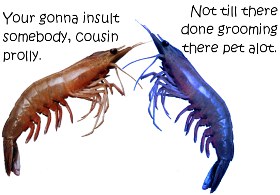
Meet Rude Cousin Prolly

There are spelling and grammar errors that can make you look astonishingly lazy, and then there are spelling and grammar errors which simply make you appear stupid. The lazy errors happen to the best of us. I have never read a book that did not have an error, somewhere, even after many rounds of professional editing. Hekc, you may even find an error here on my blog.

I cannot expect people to be perfect, but what I can do is have a whole lot of fun at their expense. Perhaps you do not feel strongly about these failures of education, but do you ever read something which indicates that you are shopping in the wrong place?

I encounter horrible spelling and grammar every day, and I often wonder how these perpetrators of illiteracy keep up their fight to grow a business. Below are some brain-failures I hope to one day see eradicated.

Your Prolly May Hate Me For This

I think the first time I saw “prolly” used in somebody’s marketing material, I wondered what other kind of seafood they had. A “prolly” is the deep sea cousin of a prawn, right? Otherwise, I am at a loss to understand how anybody could slaughter a word so horribly.

I later learned that they were probably referring to the probability of business failure for being so damn lazy. “Prolly” is not a word, but if it ever becomes a word, I imagine that it will probably be used to describe a deep sea crustacean.

You’re Not Using Your Head

“You’re” is a contraction that means “you are” and “your” is a second-person pronoun meaning something belonging to the subject, you. “Ur” is deep sea text messaging code that the prolly kids use to keep grown-ups from understanding what the heck they are saying.

If you try telling me “your going to love our stuff” you had better be giving it away, because I am not buying it. My what is going to love your stuff? My wife, my kids, my libido? If you say “your going to love our stuff” you need to add something to help me understand you better. Perhaps you meant “your prolly is going to love our stuff!”

If you use “ur”, I may boil you in a seafood gumbo. There is not even a “dumb camp” for people so dumb to try and pass off “u” or “ur” as words. That is, unless you’re a 14 year old prolly girl and want to disarm the boys by downplaying your intelligence.

The words “you’re” and “your” are not even close to the same thing, and they are pronounced differently as well. Maybe understanding the pronunciation will help you to remember the correct usage. “You’re” begins with the sound of the word “you” and since it is a contraction, it slurs in the word “are”. Try it out and begin with “you” and add “are” and keep slurring them together faster until it sounds right.

The pronunciation of “your” rhymes with lore, more, store, and whore. So if you think about using the word “your” try using it as follows: “Your store is creating more lore.” Now remember that if you are talking about somebody’s whore, you can use the word “your”, because it is something they posses. It is their whore, and it shows possession. On the other hand, if you say “You’re whore”, you just called them a whore, because you said “you are whore”. That makes it more personal and is more likely to start a fight than simply talking about the whore they possess. You might just as well talk bad about their prolly while you are tossing around the insults.

One more thing: “Youre” is another prolly word. Please refrain from using it unless you are deep in the ocean and related to prawns.

They’re Going to Take Their Money Over There

If you don’t get this one by the time I am done, you should be sent to swim with the prolly. Again with the damn contractions. I largely avoid contractions, in speech and in writing, but they are widely accepted in the twisted version of the Queen’s English that is used in my country.

“They’re” means “they are”, “their” means that they possess it, and “there” means somewhere else or the existence of something. Here is some practice for you to consider: There is a good chance they’re going to take their money over there if you screw these up. Now read this sentence again and think really hard.

There is a good chance they’re going to take their money over there if you screw these up.

“Their” is a personal pronoun. If you remember that lesson about “your whore”, just flip that around and now you are talking about their whore. If you get this wrong they’re probably going to take their money somewhere else … over there.

Your Till Will Ring Less ‘Til You Stop Abusing This

Note that I have edited this for clarification after receiving a comment (below) assuming I had a problem with using “till”, which is not the case. The problem is in trying to make a contraction of “until”. Think for just a moment about the word “until”. Until is just five letters long, but I see a lot of people who try to shorten it. If you want to shorten “until” consider how you may do so with the least absurdity. Would you add another letter to the word that did not previously exist and say “till“. That seems kind of useless, considering that you just removed one letter and added another letter plus one more character. In this case, maybe you mean the word till. Otherwise, “until” is still five characters long in this iteration ( ‘-t-i-l-l ), but it makes you look five times as stupid! I suppose you can get a down home feel by using “’til“, which would be the correct usage if there were an acceptable contracted version of until. On closer inspection you may notice that it is still only one character shorter.

A “till” is a place where money is stored, or something you do to the field before you plant corn to make your whiskey. Until you understand that “until” only has one letter “L”, and that till is not a contracted version of until, you may sound like you are drinking from a still. At least you will sound like a hillbilly for trying to make a contraction of the word until, in case that is what you are after.

The Alot Eats Prolly

I find a lot of people who like the “Alot”, but they abuse him. The Alot is a unique creature, and should not be taken for granted. I do not have a lot better way to describe the Alot than to introduce you to the creature in a blog article titled “The Alot is Better Than You at Everything“. Here is a snippet for you:

The Alot is an imaginary creature that I made up to help me deal with my compulsive need to correct other people’s grammar. It kind of looks like a cross between a bear, a yak and a pug, and it has provided hours of entertainment for me in a situation where I’d normally be left feeling angry and disillusioned with the world.

For example, when I read the sentence “I care about this alot,” this is what I imagine:
(see Hyperbole and a Half)

I have just one more thing to mention on the subject. Get your “‘s” (apostrophe s) and “s'” (apostrophe s’) right. If it needs an apostrophe or does not, you should learn the difference and also the correct placement. Otherwise, don’t blame me if your customer rides their alot over there to another store to buy their prolly.

What Makes You Want to Rant?

I could go on with rants about bad grammar until I am as blue as a prolly. What makes you want to rant? Perhaps it is people who correct your grammar? ๐Ÿ˜‰

Why Do SEO Lie? Their Customers Demand It!

Can You Handle the Truth?

You can often catch me defending the importance of search engine optimization, but I am just as likely to criticize the industry. Actually, I tend to be more critical than defensive, but today I am defending the industry honor. This is because although there are a lot of slimy, no good, low-life, bottom feeding, liars, cheats, and rip-off search engine optimizers on the fringe of my industry, there are also many SEO with integrity. These are the men and women in the SEO field who work hard and uphold good business values and deliver on their promises. These are people who take pride in their work and are as excited to see their clients succeed as the clients themselves. So the question must be asked, “Why do SEO lie?” and we should also question the reasons it has become an expected norm in the field. It turns out that a lot of people simply cannot handle the truth and the market started demanding lies. The truth is that it takes more time, knowledge, and expense than most SEO will be willing to tell you. The lies are a whole lot easier for most people to take.

I have done a lot of thinking about why SEO lie and I think I have some good insight to the matter. I have been in the Internet business since about the time graphical browsers came into existence and I have earned millions of dollars for myself and my clients as a search engine optimizer. This is nothing new to me, and I have watched the evolution from beginning through today. I want to share a bit of that with you, and I hope you will understand this from the point of view of a guy with no reason or intent to lie to you. Note that although I may say I am “for hire”, I am extremely selective about who I will work with, and it is statistically unlikely that you will be one of them. That said, if I bullshit you once, just stop reading and move on.

SEO was once a field in which the biggest challenge was to help people understand the value and the need to be listed at the top of search engine results. Being listed as number one in search results delivers many times the return of being listed lower. If you want to learn more about the math, just read the article “Improve SEO Return on Investment (ROI) With Simple Math“.

A Reason to Perform SEO

I will tell you why I entered the industry of search engine optimization for hire, and fell in love with it. Once upon a time, I merged two companies and created a monster. When I say a monster, I mean something big and with teeth that could bite the head off the competitors. We were in the field of website development, web hosting, Internet access and many other things Internet-related. We quickly found that marketing online was really effective, and we made a stand in the wholesale end of the Internet as the geeks behind the geeks. We found ourselves providing Internet access and web hosting services to over 2,000 Internet service providers and web hosts. It soon got to a point when we made calculated efforts to avoid the retail customer. We were doing so well at wholesale services that I often found myself saying “business is great if it wasn’t for all these damn customers!” What we knew was that it had everything to do with our reach in search engines, and so that was obviously an important service offering. What this means is that I joined the industry because I was already successful at it for my own services. I did not enter the SEO field to earn money, I entered it because it was already earning me money.

By providing SEO services to our customers, our customers can sell more, and in the wholesale end of the industry, that is great. Making customers successful means that they sell more, and since the service our customers sell comes from us, it is an obvious formula for success.

Where SEO Lies Began … The Money

Because SEO was such a lucrative field for top performers, it only made sense that there would eventually be an ugly turn in the market. When money flows fast and easy, it is very alluring for every con artist with a computer and a modem. Don’t tell me you have not seen this sort of greed online unless you have never received an unsolicited email for pharmaceuticals. SEO took on an ugly face as it was flooded with people making false claims and unrealistic promises. This was bolstered with extremely high demand for quality search engine optimization that could not be met by the relatively small number of good SEO vs. bad SEO, and due to the huge growth of the Internet.

High demand created a challenge for many SEO, because the industry not only had to explain the needs and benefits of search engine optimization, but also to defend themselves against a growing public perception that was created by the fringe of our industry trying to cash in on the latest craze. This created a market where legitimate SEO had to compete with liars with nothing to lose. On the surface, it put us at a disadvantage, because we planned to be there for the long haul, while the SEO who lie are just there to collect their money and move on and change their company name as needed. In many instances it caused the skilled to stand out, but many SEO took a stance that “If you can’t beat ’em, join ’em.”

SEO is Flooded In Recent Years

SEO has taken some obvious directional changes over the past couple years as companies desperately seek cost-effective answers to their marketing needs. The most sensible answers are usually not the easiest or most comfortable for businesses, and this paved the way for an even larger majority of fringe SEO willing to lie to get their business. Many dirty SEO have preyed on notions that if it is cheaper, it must be lower risk, and that search engine optimization is something way over the customer’s head.

The Internet has grown at an astonishing rate, and along with that, there is a huge population of website owners who know so little about the Internet that they are very easy to cheat out of their money by offering them false hopes. Just consider how easy it would be to lie and cheat somebody who knows little to nothing about an industry, and has little patience to learn enough to make good decisions. Then add in the desperation of a recession and you have a formula for disaster.

Many people launching a new website are of the mindset that it will be a quick and easy way to rake in a ton of business and that SEO must be pretty much the same everywhere. This is a huge open door to fraud and misrepresentation of the industry as something confusing and technical. Just imagine how easy it would be to make up a few catchy lines to confuse the public and haul in the money.

What really hurt the industry over time is that as more of the professional SEO who really do know the industry and do a good job for their clients are asked to justify the cost of SEO, more of them lowered their standards to become affordable. It made it likely for honest SEO to take on projects without the resources they needed and only deliver a fraction of what they otherwise could. It started going downhill from there, and it began to blur the lines between the skilled and the unskilled. It caused many of the good SEO to tell seemingly innocent lies of the hard work and long hours it really takes to do the job well. It lowered the good just a little closer to the level of the liars. This also drove many of the good search engine optimizers out of the SEO-for-hire market to focus on their own SEO projects.

Why Would a Good SEO Need You?

It is important to consider that good search engine optimizers who know the job can choose their products and choose their clients. Any time you hire a good SEO, you are buying their time away from other projects, and that creates a cost to them in the way of lost opportunities elsewhere. The best results often come from the SEO who chooses to work for hire because they love it. All the same, they will expect to be compensated well to achieve your success, and often in the form of “pay for performance“.

On that note, I will say that the continued decline of the SEO-for-hire industry is the reason I have recently been blogging less frequently than usual. I am working on my own projects and taking less time to share my talent with others. After all, for the good SEO with integrity and knowledge, we will always earn more by doing the job for ourselves than to do it for our clients. I hope that you will consider this fact when you seek a search engine optimization provider.

I know, my picture says “For Hire”, but the truth is that it is only for those rare few who are not fooled by the lies. It would take a couple sticks of dynamite and a bulldozer to fully drag me away from some of the projects I am working on. Either that or a client with a real understanding of the job at hand and willing to realize that much of what they hear about SEO is a lie. Especially the notion that it is cheap, easy, or the same everywhere.

Search engine optimization done well is worth the effort and the challenges. It is what makes companies more successful than their competition, and it has an important place in nearly any business. I have no reason to lie to you about that.

Good search engine optimizers will agree with the decline of integrity in the industry, while others will prefer to sweep this bit of ugliness under the rug and keep on lying. There will always be those with integrity to defend. In my case, I feel like I can defend SEO for hire more effectively from the outside looking in, and separating myself from what I see as a good market gone in a bad direction.