SEO Tip: Great Search Engine Optimization Means Paying Attention

Great SEO Involves Fine Details


My SEO tip today is about paying attention and taking action. There are about a squillion things that influence good SEO, and even more things are required to achieve great SEO. Paying attention to details can sometimes make the difference between good SEO and great SEO. Do I have your attention yet?

You are not, I repeat NOT going to get the best results that you seek from this article if you do not pay attention to detail. Good SEO has a lot to do with very fine details, and it often means paying attention to the details that the rest of your industry neglects. Today I am going to give you some thought-candy about the links which point to your website, but first, I am going to be sure that I have your full attention and that you are ready for this brain-exploding tip.

I think a lot of people try to make SEO seem a lot harder than it actually is. Really good SEO is actually quite tricky and time consuming, but there are many things that are pretty simple and tedious, but just need to be implemented properly. Knowing all of those simple and tedious tasks, and how they fit into the big picture of your search engine optimization strategy, and using them properly to receive optimal benefit is why people hire a search engine optimizer.

Squillions of people write tens of thousands of tips each day about search engine optimization. The good search engine optimizers choose their topic carefully, title it just right, tag the information well, add it to their search optimized website, and are sure to address it to the proper audience using just the right keywords. Then they emphasize the call to action, and make it clear why you found the information.

Good SEO (search engine optimizers) write their tips similar to the way they will perform SEO for their clients. In fact, you can tell a lot about them by the tips they give you (it is one of my top reasons to blog). Further, they provide the tips in the same way they expect their readers to implement their suggestions for those who try to take the do-it-yourself (DIY) SEO method.

The Great SEO will take a little additional time to do all of the things the rest of the world can only call “magic”. I do not want to let you down today, but this SEO tip is not designed to make a do-it-yourselfer a great SEO. It is just another piece in the puzzle that will help you to understand good SEO. I will say, however, that it is a pretty damn good tip that can help you move just a little closer to great. I still have to keep you reading regularly, so I cannot just give you that “SEO magic” all at once. Your head would explode, and I cannot have that on my conscience. Yes, imagine that, a search engine optimizer with a conscience … I guess there is just magic in the air today! Besides, I still want to leave you some reason to call on me when you have pulled all your hair out and get sick of letting business pass you by.

Now, on with today’s SEO tip!

Who Links to Your Site and Why Should You Care?

Links are at the front line of search engine optimization. The more high-quality links that point to your website, the easier it will be to rank for the things your site is about. The text within those links makes a huge impact on your ranking for certain topics. This is why many links to my blog include the words SEO and social media marketing. Those things are a focus of my blog, so it only makes sense that the links reflect this.

When important websites with a lot of authority start linking to my blog, I want to know it. I also want to be sure that they continue to link to my blog. I can control this in a couple ways, and the best of which is to keep producing consistently useful content. You know, the stuff people want to link to. Thanking them is not such a bad idea, either.

Another way to be sure the link-love keeps coming is to watch what received good links and write more of that. For example, a useful tip about a given topic (in this case, SEO) will often find its way into a lot of good streams of content, including both automated and manual linking. The automatic ones are pretty easy to manage, but the links created by people are a bit more tricky. You have to really blow somebody’s hair back to make them take the action of creating a link to you in their blogroll, or to submit your content to Digg, StumbleUpon, Twitter, and etcetera. If you want them to write about it and link to you in a blog post, you practically have to reinvent electricity or come up with something so amazing that they want to print it out and rub it all over themselves. Short of that you must at least write about things that people want to read, and present it in a fashion they will keep reading.

Finding Your Best Backlinks

You should know who is linking to your website. I don’t mean just the links that are being clicked on. I mean the links that make your site more visible and valuable to search engines. Here comes a big fat juicy SEO tip for you. It is called Open Site Explorer and the information it can tell you is more than you may see on the surface. Yes, this is where you have to pay attention to the details. For example, I just looked at an Open Site Explorer report for this blog and found the interesting facts as follows:

The Technorati tag “guerrilla-marketing” has produced a link pointing to my blog article titled “Marketing Without a Budget: Guerrilla Marketing Tips“, but the new content under this tag has moved my link off the page as newer articles arrived. So it seems to me that since that link is from a valuable source page, I should probably write something about guerrilla marketing and be sure to tag it with “guerrilla-marketing”. Oh yes, this article is kind of Guerrilla Marketing related … gosh, I am glad I was paying close attention. I am going to add that tag in this blog post.

I also noticed that there was a pretty nice link from the tag “whiteboards” that pointed to my article titled “Smart Slate, Smart Airliner, and Other Interactive Slates“. Perhaps I should write a follow-up to that piece and tag it appropriately.

My point is that if you pay close attention to the things which make your website rank well, there is a lot clearer path to success. Knowing that I am in the blogroll of great blogs like the ones listed below can give me a lot of reason to want to throw back some link-love to them and also keep reading their work.

These matter to me, and certainly deserve my attention (Thanks Guys). After all, they show faith in my work by linking to me. To some people, this is just a small detail, but to me it is a really important factor.

Paying attention to the sites linking to you, both automated and manually, can make a huge difference in your success. Now the question that remains is this: What will you do with this information? Were you paying attention and will you use what I have suggested? I want to guess the answer is “yes”, but there are a lot of people who do not pay attention. I hope those are your competitors and not you!

Websites As Low As $175,000 + $25,000 Monthly Maintenance

A Jackass Called Me
A Jackass Called Me


Are you in need of a real bargain for your next website? I have a great deal for you today, and it starts at just $175,000 and $25,000 per month maintenance cost. But wait! There’s more!

It sounds like a great bargain, right? Well, maybe and maybe not.

I wish I had recorded the conversation I had with a woman desperately in need of an answer about website pricing. She just wanted to hear the answer that agreed with her. She did not have any desire at all to hear the right answer. I do have the urgent voicemail message she left for me, and I will include it in the podcast.

Listen Here:

After hearing the voicemail message, I promptly returned her call and she was even more frazzled in real-time. The purpose for her call was that she was frantically seeking some way to sway her business partners from an offer made by a website development company for what she believed was astronomically high. The part she could not answer was why it was too high, or how much too high it was. All she knew was that it was too high, and she wanted ammunition to fire back at the developer and her business partners.

I agreed with her that the $175,000 plus $25,000 was extremely high for a “basic website” or “simple website”. It is funny, but from a customer’s standpoint, they usually are just “very simple”. That is, unless you take them to the mat and have them show you just how damn simple it is by telling them to do it themselves.

I did my best to calmly and logically address the woman’s concerns and told her that this amount of money should indeed buy a substantially complex website with a lot of functionality, or otherwise be justified with some really fantastic marketing services. I expressed that there was very possibly a lot of fat to trim from the price, and that I would be delighted to review her requirements and provide a competitive bid for the project. To my amazement, she really had no clue about the site’s details. She did not have a project scope laid out with details of her needs. All she knew is that she was getting the shaft from some development firm, and she needed proof that the quote was many times too high. For all I knew, the pricing she had received was the bargain of the century. She wanted to hear nothing of the truth, and instead, she hung up the phone when I told her I needed more information to determine whether it was a good deal or a bad deal.

The point is that if you are shopping for technology or marketing services, the cost is really never too high or too low without the missing variable of what you are getting for the money. There was really no way I could tell her if the quotation she had received was ten times too high or one tenth of the cost it should be. Did it require two developers or two hundred? Did it involve tens of hours or thousands of hours? Did it include software licensing and a cluster of dedicated servers, or a shared hosting account?

The trouble I see with this is that it has become far too common that people who are non-technical and have little or no understanding of an industry to seek something based on cost and not on value. These are the people who get screwed to the wall with bad results and then blame an industry instead of pointing the finger back where it really belongs, which is at themselves for making fast assumptions based on cost of things they know.

Now, if you really want to know how much a website should cost, or how to determine website development or SEO rates, I invite you to read the articles as follows:

Of course, I could write all day about different pricing models and how to determine the cost of a website project, but in short, I will just say that if the price is all you look at, you are a sucker!

I would also like to add that if you are in such a rush to get your website launched that you do not have time to hear the professional’s answers to your questions, you may be a jackass, too!

Find Good SEO: Why Good SEO Don’t Seek Your Business

Real SEO Don't Need You


Being ranked at the top of search listings on Google, Bing, and etcetera, for the things that make companies money is a very competitive endeavor. The SEO who can produce really fantastic results are few and far between. The demand is high, and the supply is comparatively low. SEO is a tricky business, and to find good SEO is kind of like finding a needle in a haystack. What makes it even harder to find good SEO (search engine optimization), is that the best SEO (search engine optimizers) are not seeking you.

Unless you sell fish milkshakes or garlic scented breath spray, you have probably noticed that there are a lot of others trying to attract the same customers as you. I should not need to explain all the reasons for wanting to be at the top of search listings, but I will say that being there is very valuable. I don’t just mean being there for your few “important” search phrases like your company name. I mean being there for the right search phrases, with the right marketing message, and a website that will convert lookers into buyers. I mean being listed for thousands of searches and maximizing your lateral keyword effectiveness. This is a job of the SEO, and we are paid to do the work that makes most people want to pull their hair out and scream at their computer. We do what others cannot do. In fact, maybe we are just a little more like Superman than we like to let on. You know, we try to be pretty humble (even though it is difficult).

Good SEO Are Not Salespeople

It has often been said that a good SEO does not need to seek business. If they are skilled at search engine optimization, there are many great opportunities open to them. This does not mean they do not want your business, but only that they are probably not banging down your door, ringing your phone off the hook, or filling your email inbox with offers of cheap SEO services. Now, I should explain that I don’t mean the ho-hum average SEO, but the ones who really deserve to carry the title of Search Engine Optimizer. There are a lot of fakes, but I have already explained how to tell the difference between good SEO and bad SEO. If you missed that article, you should make time to read and find out.

Why do I think that good SEO are not salepeople? Well, I think most SEO can probably sell SEO if they have to, but for most of us I think it gets pretty aggravating to answer salesy questions that people do not actually even care to know anyway. I mean, do you really think a client needs to know each detail of the work to be performed? Do they need to know everything the SEO knows? If that was the case, they would do it themselves. They just need to know that the SEO is good at what they do, and that they will receive quantifiable benefit from the work. Hell, I hate selling SEO, but I love performing the work. Go ahead and search Google for sell SEO and see if you find me there (Hint: Don’t look down). To me, proof should be all the selling I need to do. If somebody wants more than that, I guess I can take my shirt off and show them my sexy chest, because that would likely mean more to them than my in-depth SEO lesson that will go right over their head anyway.

Good SEO Are Quirky, But Entrepreneurial

As people, the best SEO (search engine optimizers) tend to be a little bit quirky, opinionated, eccentric, clever, and above all, entrepreneurial. SEO do not choose this work just because all the other jobs down at the 7-Eleven were taken. We do it because we have a passion for success, a competitive spirit, and often something to prove … call it a Napoleon complex if you like. SEO is a field filled with some truly astonishing marketing talent that is honed every day by constant studying of people, trends, facts, figures, and of course, the “secret ingredient” that we will never share with you because after all, you are not “in the club”.

Why SEO Don’t Seek Your Business

So, you may still wonder why I say that “good SEO don’t seek your business”, and that is something I am here to answer. The reason is this: A good search engine optimizer can take their skills to any industry, at any time, and invest themselves in that industry and earn a fortune. This is not a myth, and a good SEO can back it up. I would say that it is even true that a “pretty good SEO” can achieve a high level of success if they put enough time, study, and patience into their work in a given industry. In my case, I earned millions of dollars selling wholesale Internet services over the past decade. That did not happen because I was passionate about selling dial-up Internet access and web hosting services to ISPs. It happened because I was passionate about SEO, and I kicked that market in the ass hard enough to amass up to 2,000 resellers. It would have been even easier if I could have just been the SEO all along and not had to work as the CEO, too.

I like Cigars Just Fine

You may wonder why, if a search engine optimizer is good, they would choose to work with clients’ projects instead of selling their own product or service. This is where some people just don’t understand the required focus of SEO work. If I wanted to sell cigars online, you can bet I would corner the cigar market. I am already well listed in Google for cigar related search terms, and I am not even a cigar retailer. I don’t want to sell cigars. I do not want the hassles of operating another business … I just want to sell other people’s cigars. That is why I am a search engine optimizer. As you may have noticed, my blog is “a Web Guy” and not “a Cigar Guy”. I want to focus on making products and services successful with better SEO, and not deal with all the operational headaches of the business.

Good SEO Seek Opportunity

The reasons freelance or agency SEO consulting is so attractive to a good search engine optimizer has a lot to do with our entrepreneurial drive, and our passion for success. In order to be a really great SEO, it takes a lot of focus and love for the work. I will speak for a group when I say that most of us love wielding our success tools and reaching the top of search results and making more business happen. We think like a Mount Everest climber. We have one overall goal in mind, and that is to reach the peak.

SEO will often turn away business for reasons that you may not understand. This is not entirely about money, either. We seek opportunity, and much of the time, the client simply does not have the opportunity we are seeking.

Another reason good SEO do not seek your business is because until you understand the value of our work enough to come to us, you would never pay us more than a small fraction of what our work is worth. Unless you understand that we pay you more in increased business and brand recognition than you will ever pay us, you are just not ready.

Consider how you would react to a qualified SEO with a track record of success and a proposal that he or she will work tirelessly over the next year to make your product or service offering more visible, with better brand recognition, higher conversion of lookers to buyers, higher profit margin, and they can back it up with real numbers. They even come to you with legitimate SEO guarantees that make sense to you. How do you answer to that? Do you say “No, I am totally happy where I am … I don’t really want more customers.” If that is the case, which sometimes really is the case, then why in the name of all things intelligent are you reading this blog? You want more business or you should be reading something a whole lot more suitable to sitting in a rocking chair or moving to Florida to play golf. No, instead, you want more business, and you want to know ways to make that happen.

Once you accept this, the only obstacle left is for you to get up off your wallet and push your marketing “Go” button. Just don’t ask a qualified SEO to start begging for your business or offering you discounts while you are getting more out of the transaction than they are.

Summary: The best SEO are the ones you find, and not the ones who found you.

Marketing Fail: You Want to Sell Me What?!

The Internet Marketing Dodo


Have you ever wondered how there came to be so many Internet marketing experts and search engine optimizers in the world? My guess is because it is so darn easy a caveman could do it. At least it seems that is what they were told back at marketing school.

I love marketing. It is the only reason I watch the Super Bowl. I love to see great marketing, and to watch companies take off like an eagle. The unfortunate reality is that unskilled marketing flies with all the grace of the dodo bird.

I want to share two extreme examples of marketing failure I have recently been assaulted by. I received each of these in just the last few hours, and they come in great abundance each and every day. I think these examples explain a lot about why I encounter so many people skeptical about their marketing efforts. It is this kind of marketing that damages my whole industry.

Marketing Fail One: “Mould Providing”?

I will start with an email message I received only a few hours ago offering to sell me molds. Molds? Yes, molds! Why somebody would try to sell me molds is way over my head. This marketing failure was not only way off the target audience, but they even spelled the product name differently (language variance) in the subject line and body of the email. Then they went on to write the email as if they were the SEO just out of search engine optimization school trying to make the most of their keywords. I guess they needed to search engine optimize their email for some reason. Needless to say, I will not be purchasing any molds (or moulds either), so don’t even go there!

This goes well beyond just a language or cultural barrier, so before you give this “Marketing Engineer” a break, consider how he and millions of other spammers like him damage the marketplace for others. They collectively hinder the attention span and trust of each of us and make us more stubborn about our marketing expectations.

Subject: Mould Providing
Dear Sir/Madam,

Our company, King Mold Limited is located in Shenzhen City Guangdong province of China. We are middle size of mold maker company and about 100 machines in house. We made about 500 molds last year and 90% molds were exported to Europe, North American and other oversea areas.We are able to make small and simple molds, big and complex molds, we have made some insert molds, overmolds, two shot molds, gas assistant molds, unscrewing molds, hot runner molds and complex molds with many sliders drived by hydraulic cylinder.

Thank you for your time in advance. Your prompt attention will be highly appreciated!

Sincerely yours,

Tony /Marketing Engineer

You may be curious how Tony the Marketing Engineer targeted me for this brilliant marketing campaign. Yes, I was curious, too. You know, I love tracking things, because I am a marketer. This particular marketing failure came by way of email addressed to “thebigcheese@veryimportantguy.com” which is an address that I used in only one place … ever. That was in a blog article I wrote at “Mobile – Local – Social” titled “Cc: How Social Media Killed Email“, and I knew at the time some email spiders would come and scoop up the email address.

Marketing Fail Two: First Page Google Listing

First, I want to explain that this email came from my contact page here at aWebGuy.com and the sender had to pass a Captcha form to send it. What makes me want to reach out and ring the collective neck of this form of marketing “expert” is that it has lead a lot of people to really think of search engine optimization (SEO) as a joke. Here is the email I received:

Want more clients and customers? We will help them find you by putting you on the 1st page of Google. Email us back to get a full proposal

I wonder what, exactly they would like to get me ranked on the first page of Google with. Maybe the term “how to sell SEO“? Oh yeah, but I am already ranked in the top two for that search, and it has nothing to do with spamming people. I am already there for about a squillion competitive industry terms. I mean, it is what I do professionally. Maybe they can get me on the Google home page just under the logo … how much does that cost?

What really drives me nuts about this is that although it separates the good SEO and bad SEO, it still gives a lot of companies a real reason to hate people in my industry. It makes it even harder to overcome that disgusting image of some fat un-bathed guy in a pair of filthy nylon boxers sending out email and tweeting some crap about his new “earn money fast online” scheme and how he is the real deal and he can make your company successful overnight.

Screw it … I think I’ll go back to bed. My head hurts from thinking about it. If you leave me a comment, that is fine, but I am not buying any damn SEO or molds, so put it out of your mind right now!

SEO Tip: WordPress Category Descriptions Matter

WordPress Categories Matter


SEO: It is the art and science of getting your website listed in search engine results for more search terms and listed higher than all the others. This is a pretty important factor to website success … and business success. So, it would seem tragic if you had done almost all the right things, but then you just forgot some of the basics.

Nobody is perfect. We all forget things. I want to give you a reminder of something that I frequently find overlooked by WordPress blog owners when they set up a new blog, and as the blog grows. The basic principle can apply to any website, really. The little things really do add up, and this is a quick SEO tip that you can use to improve your SEO so fast that you may wonder why you ever neglected it.

WordPress Category Descriptions

Sure, you have set up your categories, and you may add to them now and then. Blogs change over time, and so their focus changes. Categorizing your content is important, and so you probably did not forget that part. What I find that a lot of people do forget is to optimize WordPress category descriptions to match their content.

WordPress categories are a way to make it easier for people to find more information on the same topic. They also help search engines to better index your blog. It only makes good sense to have your category descriptions reflect the content of that category correctly, and keep it up to date.

The category description is where WordPress gets the page description for category pages to include in the meta description. If you do not have a description, or it is an old description that does not reflect changes to your blog and to the state of that category, your blog is missing an important element.

Using “Noindex, Follow” in WordPress Category Pages

You may say, “but I have a noindex, follow meta tag in my categories.” This is good, and I do, too. I use “All in One SEO Pack“, and I recommend it to others. It allows easy management of meta indexing directives.

I do not want search engines to index my categories, but I want them to know exactly what the categories are about and then follow the category page links to my article pages. It makes sense that I should give them a good meta description.

It may seem trivial, but when you consider it, many of the things we do to optimize our websites for search engine ranking really are just little pieces. Those little pieces add up to be one big picture, and until you get them all together, the puzzle is still not complete.

Managing WordPress Category Descriptions

Just to be sure I did not give you a great idea and motivate you to take action, but not follow through with a “how to”, I will tell you a couple of tips on where to go and do this, and also what to include.

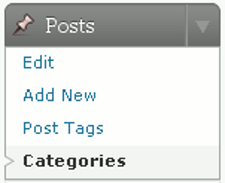
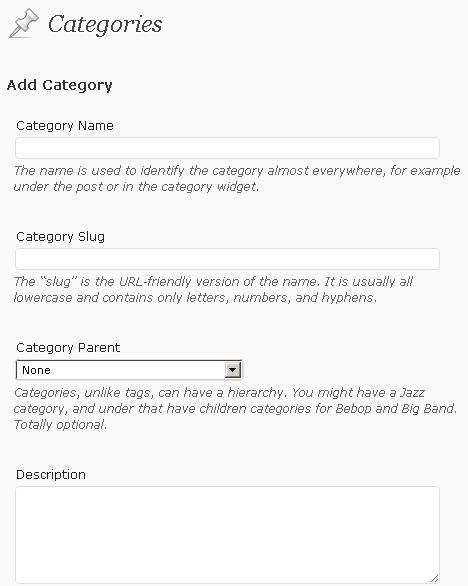
First, for anybody unfamiliar with where to edit WordPress categories. Depending on the version of WordPress you are using, you will find it in your blog administration either under “Posts” and then “Categories” or under “Manage” and then “Categories”. From there, you will see all of your categories listed. Simply click on a category name and add or modify the description. I would not suggest changing the “slug”, because it would change the URL and upset your internal link structure and search engines would have to learn it all over again.

Editing Word Press Categories is Simple

Now that you are ready to edit your blog categories, try to create a description that reflects the emphasis of the category, and how it relates to the overall content of the site. As an example, my “Internet Marketing” category description reads as follows:

“Internet marketing has many sub-categories and this information focuses on marketing content creation, SEO, and social media marketing.”.

As you can see here, it reflects the blog category, but it also reflects how it relates to the overall subject of the blog.

I hope you have found this to be useful. It is sometimes easy to forget the little steps, but they all matter.

For more useful WordPress-specific tips and tricks, I recommend my friend, Ruhani Rabin‘s blog. Here is a link directly to his WordPress category where he has a lot of useful articles about tweaking WordPress blogs.